Workshop: Recent Trends in Language Education and Applied Linguistics

LEVERAGING THE 4CS FRAMEWORK FOR EFFECTIVE EAL INSTRUCTION
Le Thi Tuyet Minh, M.A.
snowle@ueh.edu.vn
Abstract
The 4Cs framework, proposed by Coyle et al. (2010), offers a comprehensive approach to Content and Language Integrated Learning (CLIL) that aligns with the demands of 21st-century education. By integrating content (subject matter), communication (language learning and using), cognition (learning and thinking processes), and culture (developing intercultural understanding and global citizenship), this framework empowers learners to acquire both content knowledge and the essential language, cognitive, and cultural skills needed to thrive in our contemporary world. With its well-defined components and far-reaching implications for classroom practice, the 4Cs framework holds significant potential for enhancing English as an Additional Language (EAL) instruction. By carefully considering the specific needs of learners and the context of instruction, educators can effectively implement this framework to prepare students for the challenges of the 21st century.
THEORETICAL FRAMEWORK FOR ESP COURSE DEVELOPMENT
Vo Dinh Phuoc, M.A.
vdphuoc@ueh.edu.vn
Abstract
This paper proposes a framework for developing and implementing English for Specific Purposes (ESP) courses at the School of Foreign Languages (SFL) of UEH. ESP courses are tailored to the requirements of practical language skills that are directly applicable to their academic studies and future careers.
The paper outlines key concepts in ESP, including its historical development, distinguishing features from General English, and the importance of needs analysis in tailoring courses to learner objectives. Also, it emphasizes the multifaceted role of teachers in operating an ESP program. The paper further delves into ESP materials design, advocating for developing self-designed materials aligned with learner needs. Finally, the importance of ongoing evaluation for course improvement is emphasized. By providing a comprehensive theoretical framework, this paper aims to empower SFL teachers to design effective ESP programs, ultimately enhancing the quality of English language teaching and learning at UEH.
Keywords: framework, ESP, course development, General English, needs analysis, materials design, teacher roles, ongoing evaluation
SUGGESTED MODEL FOR ESP READING LESSON DESIGN
Vo Dinh Phuoc, M.A.
vdphuoc@ueh.edu.vn
Abstract
This paper proposes an approach to designing effective English for Specific Purposes (ESP) reading lessons. By drawing on established theories and practical insights, the model aims to enhance learners’ reading comprehension and language skills. The suggested model incorporates a series of steps, including vocabulary pre-teaching, pre-reading activities, multiple reading strategies (scanning, skimming, and in-depth reading), comprehension checks aligned with Bloom’s Taxonomy, post-reading discussions, and supplementary activities. This framework provides ESP teachers with a practical tool and clear-cut procedures to create engaging and effective reading lessons that cater to the specific needs of their students.
Keywords: ESP, lesson design, reading strategies, specific needs
Teacher change through a professional development program: A case study at a Vietnamese university
Kieu Huyen Tram, M.A.
kieuhuyentram@ueh.edu.vn
Abstract
This research explores teacher change within a professional development (PD) program for blended learning, conducted at a Vietnamese university. Blended learning, while widely promoted, often raises questions regarding its effective implementation and teacher readiness. Through a qualitative case study, this research examines six EFL lecturers participating in a Community of Practice to develop blended learning competencies. The project is divided into three studies: a baseline assessment to understand teachers’ initial practices and concerns; an evaluation to investigate the effects of the implemented three-phase PD program that includes foundational learning, collaborative material design, and practical application; and an escalation stage where ongoing teachers’ concerns are shared with department and university administrators. Findings reveal improvements in teachers’ blended learning practices and persisting concerns shaped by institutional factors. This study might contribute to teacher change theories and offer insights into effective PD for blended learning, with implications for educational contexts similar to Vietnam’s.
AN OVERVIEW OF BLENDED LEARNING
Truong Thi Anh Dao, M.A.
adao@ueh.edu.vn
Abstract
Blended learning, which combines in-person teaching with online educational experiences, has become increasingly popular. This paper reviews the key aspects of blended learning, its evolution, and its influence on education. The goal of integrating technology into the classroom is to boost student involvement, tailor learning experiences, and provide broader resource access, accommodating varied learning preferences. Different blended learning models—like flipped classrooms, rotation models, and flex models—are examined to assess their success at different educational stages. The study also highlights blended learning’s role in developing essential 21st-century skills, such as self-management, digital literacy, and teamwork. Implementation challenges, including the need for technical support, digital accessibility, and proper teacher training, are addressed. Drawing on recent studies and examples, this paper aims to offer a thorough understanding of blended learning’s advantages, drawbacks, and potential to transform education and prepare students for a digital future.
Keywords: blended learning, flipped classrooms, digital literacy and educational technology
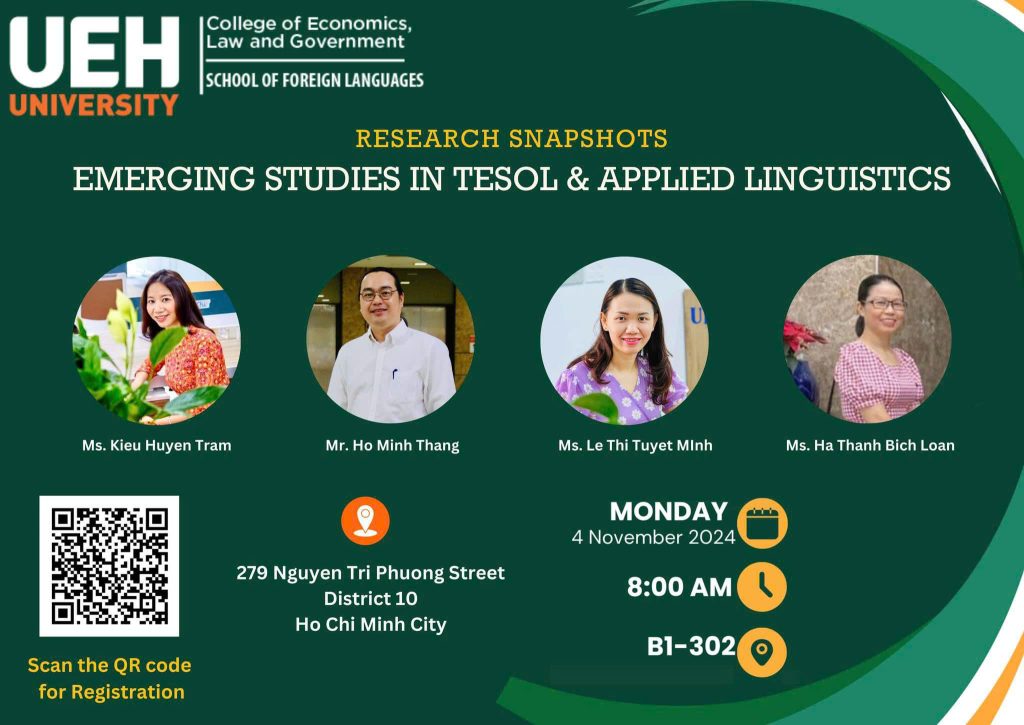
Self-determination Theory and Vietnamese EFL Learners’ Motivation: Potential Future Directions
Ha Thanh Bich Loan, M.A.
loanhatb@ueh.edu.vn
Abstract
Motivation plays a significant role in foreign or second language learning. There have been various theories of learner motivation, but Self-Determination Theory (SDT) by Deci and Ryan (1985) – a comprehensive psychological framework for research on healthcare, sports, work, and education – appears to have received limited attention, especially in the Vietnamese context of EFL teaching and learning. SDT highlights the importance of satisfying the three basic human psychological needs (autonomy, competence, and relatedness) to foster intrinsic motivation. First, unlike learner autonomy in second language acquisition, which mentions independent learning, autonomy within SDT refers to autonomous motivation (a sense of freedom of choice in learning). Besides, competence is an indispensable need to boost learner motivation; e.g., teachers’ positive feedback can make students feel competent, hence motivated in their learning process. Finally, relatedness is also crucial for enhancing learner motivation. When feeling connected with their teachers and classmates, students tend to willingly engage in classroom activities, and stay motivated in their learning journey as well. SDT is like an umbrella theory with six sub-theories under it. This indicates great potential for future research on learner motivation in general, and EFL learner motivation in particular.
Keywords: SDT, learner motivation, autonomy, competence, relatedness
CULTURE SHOCK AMONG VIETNAMESE INTERNATIONAL STUDENTS: CAUSES, EFFECTS, AND RECOVERY
Thai Hong Phuc, M.A.
thaihongphuc@ueh.edu.vn
ABSTRACT
The data from various sources, such as the Vietnamese Ministry of Education and Training, private consultancies, and international reports indicate that Vietnam is one of the major sources of international students globally, with Korea, Japan, Australia, and the US being the most favored destinations. The factors that influence Vietnamese students to seek higher education abroad are academic reputation, quality of education, and permanent residency opportunities in the developed countries, especially the English-speaking ones. This paper aims to explore the phenomenon of culture shock and its impact on international students who seek higher education abroad. These students have many opportunities, but also face difficulties when living and studying in new environments. One of the challenges that they have to cope with is culture shock. The paper starts by defining culture shock and examining its main sources and effects. Afterwards, it provides some suggestions on how overseas students can prepare for and overcome the difficulties of cultural adaptation. Lastly, it proposes some actions that can be implemented by the host institutions and communities to facilitate the academic and social integration of international students. Therefore, this paper is beneficial to international students in general, overseas Vietnamese ones in particular, who intend to pursue higher education in foreign countries.
AN EXPLORATION OF EFL STUDENTS’ PERSPECTIVES
ON LANGUAGE LEARNING ANXIETY
Nguyen Phu Quynh Nhu, M.A.
nhunpq@ueh.edu.vn
Abstract
This study explores the anxieties that English as a Foreign Language (EFL) students experience during language acquisition. Drawing on the foundational work of Horwitz, Horwitz, and Cope (1986) and incorporating insights from Gregersen, MacIntyre, and Olson’s (2017) exploration of innovative anxiety reduction methods, the research aims to identify common anxieties among EFL learners and propose effective strategies for addressing them. Employing a qualitative approach, the research collected data through semi-structured interviews with 30 EFL students from diverse linguistic backgrounds at a university. These students were selected via purposive sampling to ensure a wide range of experiences and insights. The interviews focused on identifying the sources of anxiety and the coping strategies employed by the students. The analysis indicated that the primary sources of anxiety were fear of making mistakes, worries over negative evaluations, and the pressure to communicate fluently without prior preparation. These anxieties were often intensified by high-stakes testing and by the perceived gaps in language abilities among peers. Effective strategies for reducing anxiety highlighted by students included peer support, positive feedback from teachers, and the use of more communicative and interactive classroom activities. The findings emphasize the need to understand student perspectives on language learning anxiety to foster more supportive EFL environments. This research contributes to the broader discussion in language education by emphasizing the importance of addressing emotional challenges in the EFL classroom, aiming to improve both the well-being of students and their educational outcomes.
EVALUATING COURSE EFFECTIVENESS AND STUDENT ENGAGEMENT: INSIGHTS FROM THE STUDENTS AT VINH LONG CAMPUS – UEH UNIVERSITY
Nguyễn Lương Hoàng Thành, M.A.
thanhnlh@ueh.edu.vn
Abstract
This research paper examines students’ thoughts and experiences after completing a course and the factors influencing their concentration levels during class time. The post-course phase is critical for students to reflect on their learning, evaluate the course’s effectiveness, and assess its contribution to their personal and professional growth. By understanding their satisfaction and feedback, educational institutions can enhance curriculum design, teaching methodologies, and student support services. Concentration is essential for effective learning, and this paper seeks to identify factors that enhance or hinder students’ focus. By exploring classroom environment, teaching strategies, student engagement, and personal characteristics, this research aims to contribute to the literature on student perspectives and concentration and provide evidence-based strategies to boost engagement and learning outcomes.
Keywords: student experiences, concentration levels, teaching strategies
WHAT ARE WORLD ENGLISHES?
Trương Vĩnh Duy, M.A.
duytv@loanhatb
Abstract
The rapid proliferation of English as a global language has long been a linguistic phenomenon that receives attention from several scholars and researchers around the world. This brings about both benefits and inevitable drawbacks. This essay aims to summarize four topics in applied linguistics to demonstrate my understanding of several aspects and features concerning this specific topic.