
The 2025 Scientific Conference Abstract book of the School of Foreign Languages compile research studies addressing key themes in contemporary language teaching and learning. The contributions span various areas, including innovations in pedagogical practices, the development of language skills, the integration of technology and AI in education, learner psychology, and the enhancement of ESP/EAP programs. Collectively, the abstract book reflects the scholarly efforts of faculty members and offer valuable insights for improving teaching practices and meeting the demands of international integration in higher education.
Category Archives: Bài báo khoa học
Workshop: Recent Trends in Language Education and Applied Linguistics

LEVERAGING THE 4CS FRAMEWORK FOR EFFECTIVE EAL INSTRUCTION
Le Thi Tuyet Minh, M.A.
snowle@ueh.edu.vn
Abstract
The 4Cs framework, proposed by Coyle et al. (2010), offers a comprehensive approach to Content and Language Integrated Learning (CLIL) that aligns with the demands of 21st-century education. By integrating content (subject matter), communication (language learning and using), cognition (learning and thinking processes), and culture (developing intercultural understanding and global citizenship), this framework empowers learners to acquire both content knowledge and the essential language, cognitive, and cultural skills needed to thrive in our contemporary world. With its well-defined components and far-reaching implications for classroom practice, the 4Cs framework holds significant potential for enhancing English as an Additional Language (EAL) instruction. By carefully considering the specific needs of learners and the context of instruction, educators can effectively implement this framework to prepare students for the challenges of the 21st century.
THEORETICAL FRAMEWORK FOR ESP COURSE DEVELOPMENT
Vo Dinh Phuoc, M.A.
vdphuoc@ueh.edu.vn
Abstract
This paper proposes a framework for developing and implementing English for Specific Purposes (ESP) courses at the School of Foreign Languages (SFL) of UEH. ESP courses are tailored to the requirements of practical language skills that are directly applicable to their academic studies and future careers.
The paper outlines key concepts in ESP, including its historical development, distinguishing features from General English, and the importance of needs analysis in tailoring courses to learner objectives. Also, it emphasizes the multifaceted role of teachers in operating an ESP program. The paper further delves into ESP materials design, advocating for developing self-designed materials aligned with learner needs. Finally, the importance of ongoing evaluation for course improvement is emphasized. By providing a comprehensive theoretical framework, this paper aims to empower SFL teachers to design effective ESP programs, ultimately enhancing the quality of English language teaching and learning at UEH.
Keywords: framework, ESP, course development, General English, needs analysis, materials design, teacher roles, ongoing evaluation
SUGGESTED MODEL FOR ESP READING LESSON DESIGN
Vo Dinh Phuoc, M.A.
vdphuoc@ueh.edu.vn
Abstract
This paper proposes an approach to designing effective English for Specific Purposes (ESP) reading lessons. By drawing on established theories and practical insights, the model aims to enhance learners’ reading comprehension and language skills. The suggested model incorporates a series of steps, including vocabulary pre-teaching, pre-reading activities, multiple reading strategies (scanning, skimming, and in-depth reading), comprehension checks aligned with Bloom’s Taxonomy, post-reading discussions, and supplementary activities. This framework provides ESP teachers with a practical tool and clear-cut procedures to create engaging and effective reading lessons that cater to the specific needs of their students.
Keywords: ESP, lesson design, reading strategies, specific needs
Teacher change through a professional development program: A case study at a Vietnamese university
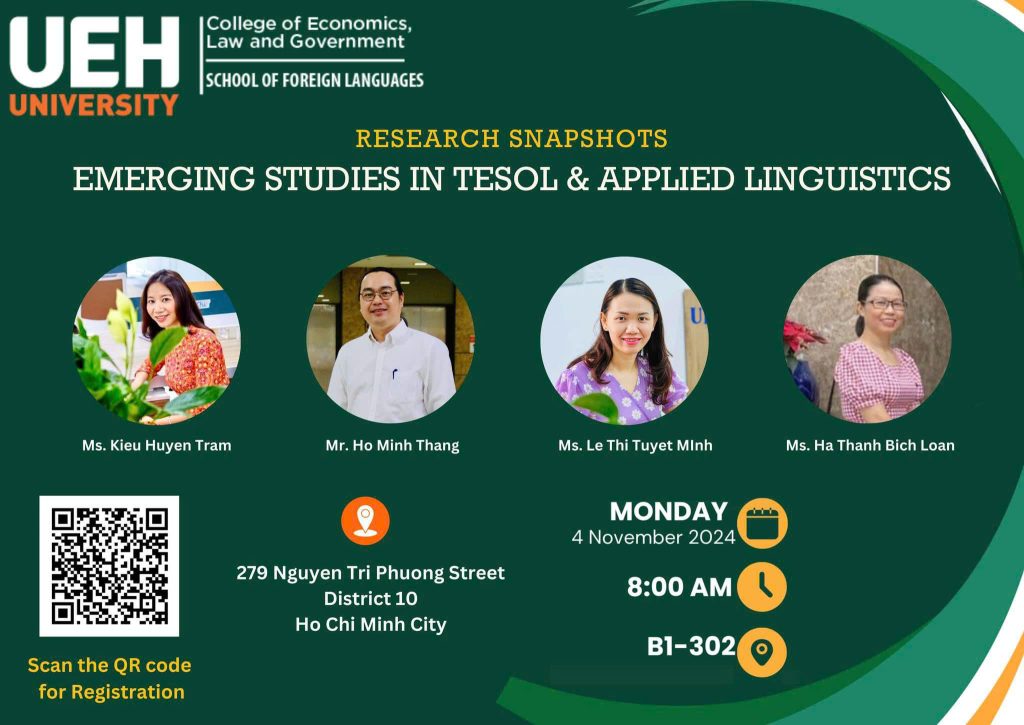
Kieu Huyen Tram, M.A.
kieuhuyentram@ueh.edu.vn
Abstract
This research explores teacher change within a professional development (PD) program for blended learning, conducted at a Vietnamese university. Blended learning, while widely promoted, often raises questions regarding its effective implementation and teacher readiness. Through a qualitative case study, this research examines six EFL lecturers participating in a Community of Practice to develop blended learning competencies. The project is divided into three studies: a baseline assessment to understand teachers’ initial practices and concerns; an evaluation to investigate the effects of the implemented three-phase PD program that includes foundational learning, collaborative material design, and practical application; and an escalation stage where ongoing teachers’ concerns are shared with department and university administrators. Findings reveal improvements in teachers’ blended learning practices and persisting concerns shaped by institutional factors. This study might contribute to teacher change theories and offer insights into effective PD for blended learning, with implications for educational contexts similar to Vietnam’s.
AN OVERVIEW OF BLENDED LEARNING
Truong Thi Anh Dao, M.A.
adao@ueh.edu.vn
Abstract
Blended learning, which combines in-person teaching with online educational experiences, has become increasingly popular. This paper reviews the key aspects of blended learning, its evolution, and its influence on education. The goal of integrating technology into the classroom is to boost student involvement, tailor learning experiences, and provide broader resource access, accommodating varied learning preferences. Different blended learning models—like flipped classrooms, rotation models, and flex models—are examined to assess their success at different educational stages. The study also highlights blended learning’s role in developing essential 21st-century skills, such as self-management, digital literacy, and teamwork. Implementation challenges, including the need for technical support, digital accessibility, and proper teacher training, are addressed. Drawing on recent studies and examples, this paper aims to offer a thorough understanding of blended learning’s advantages, drawbacks, and potential to transform education and prepare students for a digital future.
Keywords: blended learning, flipped classrooms, digital literacy and educational technology
Self-determination Theory and Vietnamese EFL Learners’ Motivation: Potential Future Directions
Ha Thanh Bich Loan, M.A.
loanhatb@ueh.edu.vn
Abstract
Motivation plays a significant role in foreign or second language learning. There have been various theories of learner motivation, but Self-Determination Theory (SDT) by Deci and Ryan (1985) – a comprehensive psychological framework for research on healthcare, sports, work, and education – appears to have received limited attention, especially in the Vietnamese context of EFL teaching and learning. SDT highlights the importance of satisfying the three basic human psychological needs (autonomy, competence, and relatedness) to foster intrinsic motivation. First, unlike learner autonomy in second language acquisition, which mentions independent learning, autonomy within SDT refers to autonomous motivation (a sense of freedom of choice in learning). Besides, competence is an indispensable need to boost learner motivation; e.g., teachers’ positive feedback can make students feel competent, hence motivated in their learning process. Finally, relatedness is also crucial for enhancing learner motivation. When feeling connected with their teachers and classmates, students tend to willingly engage in classroom activities, and stay motivated in their learning journey as well. SDT is like an umbrella theory with six sub-theories under it. This indicates great potential for future research on learner motivation in general, and EFL learner motivation in particular.
Keywords: SDT, learner motivation, autonomy, competence, relatedness
CULTURE SHOCK AMONG VIETNAMESE INTERNATIONAL STUDENTS: CAUSES, EFFECTS, AND RECOVERY
Thai Hong Phuc, M.A.
thaihongphuc@ueh.edu.vn
ABSTRACT
The data from various sources, such as the Vietnamese Ministry of Education and Training, private consultancies, and international reports indicate that Vietnam is one of the major sources of international students globally, with Korea, Japan, Australia, and the US being the most favored destinations. The factors that influence Vietnamese students to seek higher education abroad are academic reputation, quality of education, and permanent residency opportunities in the developed countries, especially the English-speaking ones. This paper aims to explore the phenomenon of culture shock and its impact on international students who seek higher education abroad. These students have many opportunities, but also face difficulties when living and studying in new environments. One of the challenges that they have to cope with is culture shock. The paper starts by defining culture shock and examining its main sources and effects. Afterwards, it provides some suggestions on how overseas students can prepare for and overcome the difficulties of cultural adaptation. Lastly, it proposes some actions that can be implemented by the host institutions and communities to facilitate the academic and social integration of international students. Therefore, this paper is beneficial to international students in general, overseas Vietnamese ones in particular, who intend to pursue higher education in foreign countries.
AN EXPLORATION OF EFL STUDENTS’ PERSPECTIVES
ON LANGUAGE LEARNING ANXIETY
Nguyen Phu Quynh Nhu, M.A.
nhunpq@ueh.edu.vn
Abstract
This study explores the anxieties that English as a Foreign Language (EFL) students experience during language acquisition. Drawing on the foundational work of Horwitz, Horwitz, and Cope (1986) and incorporating insights from Gregersen, MacIntyre, and Olson’s (2017) exploration of innovative anxiety reduction methods, the research aims to identify common anxieties among EFL learners and propose effective strategies for addressing them. Employing a qualitative approach, the research collected data through semi-structured interviews with 30 EFL students from diverse linguistic backgrounds at a university. These students were selected via purposive sampling to ensure a wide range of experiences and insights. The interviews focused on identifying the sources of anxiety and the coping strategies employed by the students. The analysis indicated that the primary sources of anxiety were fear of making mistakes, worries over negative evaluations, and the pressure to communicate fluently without prior preparation. These anxieties were often intensified by high-stakes testing and by the perceived gaps in language abilities among peers. Effective strategies for reducing anxiety highlighted by students included peer support, positive feedback from teachers, and the use of more communicative and interactive classroom activities. The findings emphasize the need to understand student perspectives on language learning anxiety to foster more supportive EFL environments. This research contributes to the broader discussion in language education by emphasizing the importance of addressing emotional challenges in the EFL classroom, aiming to improve both the well-being of students and their educational outcomes.
EVALUATING COURSE EFFECTIVENESS AND STUDENT ENGAGEMENT: INSIGHTS FROM THE STUDENTS AT VINH LONG CAMPUS – UEH UNIVERSITY
Nguyễn Lương Hoàng Thành, M.A.
thanhnlh@ueh.edu.vn
Abstract
This research paper examines students’ thoughts and experiences after completing a course and the factors influencing their concentration levels during class time. The post-course phase is critical for students to reflect on their learning, evaluate the course’s effectiveness, and assess its contribution to their personal and professional growth. By understanding their satisfaction and feedback, educational institutions can enhance curriculum design, teaching methodologies, and student support services. Concentration is essential for effective learning, and this paper seeks to identify factors that enhance or hinder students’ focus. By exploring classroom environment, teaching strategies, student engagement, and personal characteristics, this research aims to contribute to the literature on student perspectives and concentration and provide evidence-based strategies to boost engagement and learning outcomes.
Keywords: student experiences, concentration levels, teaching strategies
WHAT ARE WORLD ENGLISHES?
Trương Vĩnh Duy, M.A.
duytv@loanhatb
Abstract
The rapid proliferation of English as a global language has long been a linguistic phenomenon that receives attention from several scholars and researchers around the world. This brings about both benefits and inevitable drawbacks. This essay aims to summarize four topics in applied linguistics to demonstrate my understanding of several aspects and features concerning this specific topic.

Proceedings: Advancing English for Specific Purposes through Effective Curriculum Development and Materials Design (6/2023)

DEVELOPING TEACHING MATERIALS FOR ESP PROGRAMS: AN EXAMPLE AT SCHOOL OF FOREIGN LANGUAGES – UEH
Vo Dinh Phuoc, M.A.
Introduction
The School of Foreign Languages at the University of Economics Ho Chi Minh City (SFL-UEH) is developing a new English training program for non-English major students. The goal is to replace the current General Business English program with English for Specific Purposes (ESP) programs, which will be more tailored to the students’ needs in their studies and future careers. In addition to developing the new programs, the SFL lecturers have compiled ESP teaching materials for several training majors at UEH. The materials design is undertaken under the approaches and models suggested by renowned scholars and educational experts. This paper briefly describes the process of designing ESP teaching materials with the aim of sharing experiences and highlighting the difficulties and challenges of this professional work.
INVESTIGATING THE USE OF TECHNOLOGY DEVICES IN THE ENGLISH CLASSROOM FROM THE PERSPECTIVES OF THE STUDENTS AT VINH LONG CAMPUS – UEH UNIVERSITY
Nguyen Luong Hoang Thanh, M.A.
INTRODUCTION
In recent years, the proliferation of technology devices and their integration into various aspects of our daily lives has become increasingly evident. Among the various demographic groups, university students are known to be avid users of mobile devices, relying on them for communication, information access, and entertainment. However, the use of cellphones in educational settings, particularly in the classroom, has sparked debates and concerns among educators and researchers regarding its impact on students’ learning experience and academic performance. This research paper aims to explore the opinions and habits of university students regarding the use of technology devices in the classroom. By examining the attitudes of students and their actual habits during class time, this study intends to shed light on the reasons behind this behavior and its potential consequences.
USING READABILITY TO MEASURE THE DIFFICULTY OF TEXTS IN ESP
MATERIALS DESIGN
Vo Dinh Phuoc, M.A.
Introduction
When dealing with materials design, teachers usually face issues such as material sources, appropriateness and relevance, teachability of content and tasks, or attuning to learners’ proficiency levels. In recent decades, many applications have been developed to assist language teachers and seemed to make innovative changes in teacher’s work. This paper addresses a tool of text analysis that scientifically interprets linguistic elements in measuring a text’s difficulty. This insightful method might have eliminated subjective judgments in selecting appropriate texts to develop materials suitable for their students’ difficulty level. In addition to providing a reliable measurement, this text analysis tool also helps save time, effort, and especially costs (most of which are free) to carry out activities and research projects related to language.
LA LANGUE MATERNELLE EN CLASSE DE FLE
Nguyen Thi Thien Phuong
Résumé
Dans le contexte éducatif contemporain, les approches pédagogiques relatives à l’enseignement des langues étrangères ont connu une évolution majeure, engendrant une réévaluation du rôle de la langue maternelle. Cet article analyse les courants méthodologiques du FLE afin de mettre en évidence les diverses fonctions de la langue maternelle dans le processus d’enseignement et d’apprentissage. La langue maternelle y apparaît tantôt comme une précieuse ressource, tantôt comme un écueil à éviter. Si certaines méthodes traditionnelles privilégiaient une immersion totale pour minimiser les interférences linguistiques, les avancées pédagogiques plus récentes reconnaissent les avantages cognitifs et linguistiques qu’elle procure. Ainsi, l’usage de la langue maternelle varie en fonction des approches méthodologiques adoptées, témoignant de l’évolution constante des courants didactiques.
Mots-clés : enseignement des langues – langue maternelle – courants méthodologiques
UNDERSTANDING THE VALIDITY AND RELIABILITY OF
ASSESSMENT TESTS
Nguyen Luong Hoang Thanh, M.A.
ABSTRACT
It has long gone without saying that assessment has a crucial role to play in the process of teaching and learning of every subject. Another common knowledge is that designing an assessment procedure which appropriately demonstrates student capacity is not in the least easy. Among numerous characteristics of a well-designed test, validity and reliability should be attentively taken into account. If we are to interpret the score on a given test as an indicator of an individual’s ability, that score must be both valid and reliable (Bachman, 1990, 24). These two concepts are not only essential when analyzing and using measures of language abilities but also foremost to be considered when developing and giving tests. In light of this, the research paper will discuss in depth the validity and reliability of assessment tests as well as the intimate relationship between these two qualities.
Keywords: validity, reliability, assessment
L’INFLUENCE DE LA LANGUE VIETNAMIENNE DANS L’APPRENTISSAGE DU FRANÇAIS LANGUE ÉTRANGÈRE (FLE)
Nguyen Thi Thien Phuong
Résumé
L’interaction entre la langue maternelle et l’acquisition d’une nouvelle langue est complexe. L’apprentissage des langues ne se limite pas au monolinguisme, mais implique des interactions interlinguistiques et culturelles. L’article explore comment le vietnamien peut faciliter l’apprentissage du français, grâce à des similitudes syntaxiques et des emprunts lexicaux. Utilisée judicieusement, la langue maternelle peut aider les débutants à surmonter les obstacles linguistiques, favorisant une expression orale fluide. Par ailleurs, les défis phonétiques et grammaticaux spécifiques aux locuteurs vietnamiens apprenant le français sont abordés. Une approche cognitive guidée par des enseignants compétents favorise la réflexion, la comparaison et la synthèse, renforçant la maîtrise linguistique. L’intégration avisée de la langue maternelle, la reconnaissance des similarités et différences entre les langues et une approche cognitive raffinée enrichissent l’apprentissage des langues étrangères, favorisant une compréhension et une maîtrise profondes.
Mots clés : Apprentissage – FLE – Langue maternelle – Approche cognitive
HOW TO DIFFERENTIATE BETWEEN THE PRESENT PERFECT AND SIMPLE PAST TENSES
Truong Thi Anh Dao, M.A.
When learning English, Vietnamese speakers often make grammatical errors related to tenses, especially when it comes to choosing between the simple past and present perfect tenses. For example, when translating a Vietnamese sentence that contains “đã” or “rồi” into English, learners often translate it using the simple past tense of the verb. This is correct when the action in the sentence is situated within a defined past time frame. However, when there is no specific time frame, these indicators can convey various meanings depending on the grammatical structure and context of the sentence.
SMARTPHONE USE IN ENGLISH LANGUAGE CLASSROOMS
Thai Hong Phuc, M.A.
INTRODUCTION
A smartphone is a mobile phone that can be used as a small computer and that connects to the internet (Cambridge Dictionary). Its popularity has positively changed the ways people communicate and gain information. In addition to helping in communication, a smartphone is also an efficient mobile learning device which provides people with chances to learn anywhere and anytime.

KỶ YẾU HỘI THẢO KHOA HỌC CẤP KHOA 2022
UNDERSTANDING WORD FORMATION IN ENGLISH AND VIETNAMESE
Nguyen Luong Hoang Thanh, M.A.
RATIONALE
According to Tanaka (2006), among 3000 languages supposed to exist on the Earth, English is the only language labeled “an international language”. Therefore, the position of English in the map of world languages remains unique. However, learning English is definitely not an easy task to fulfill as there are so many things to learn. Besides the skills such as speaking, listening, writing, and reading; vocabulary also plays an important role. The more vocabulary we have, the clearer and more accurate ideas we can express and the shorter the process of learning English becomes. However, people often describe learning new words as a never-ending process. What we can do is to make this seemingly difficult and boring process easier and more interesting to complete. As a consequence, a mini research is conducted to provide insight into the word formation in English and Vietnamese. Full text
*******
Nguyen Thi Bich Duyen, M.A.
Abstract
This paper aims at analyzing the article “Curriculum Approaches in Language Teaching: Forward, Central, and Backward Design” by Jack C. Richards. A brief summary of three kinds of curriculum design will be followed by a discussion for strengths and limitations of the article in general, and of each design in particular. A personal reflection including responses, relevance and implication of these curriculum approaches is also covered in accordance with Vietnam teaching and learning context. Full text
Ton Nu Tuy Anh, PhD in Linguistics
Introduction
My recent investigation into the pragmatic input in a national EFL textbook series for Vietnamese high school students reveals a paucity of explicit information on pragmatics, together with inadequate presentations of different pragmatic aspects (see Ton Nu, 2018; Ton Nu & Murray, 2020 for more information). These shortcomings of the textbooks regarding pragmatic content require teachers to play a more active role in integrating pragmatics into their lessons to facilitate the development of students’ communicative abilities in English. This has motivated me to organize a one-day training workshop for high school Vietnamese EFL teachers in order to raise their awareness of pragmatics and its teaching for their potential incorporation of pragmatics into their English lesson to help improving students’ communicative competence in the target language in the EFL contexts. Full text
*****
PHÂN BIỆT HÌNH THÁI DĨ THÀNH HIỆN TẠI (PRESENT PERFECT) VÀ HÌNH THÁI QUÁ KHỨ ĐƠN (SIMPLE PAST)
ThS. Trương Thị Anh Đào
Trong quá trình học tiếng Anh, người Việt thường mắc những lỗi ngữ pháp có quan hệ với loại hình, đặc biệt là lỗi về cách dùng thì. Chẳng hạn khi phải chuyển dịch một câu tiếng Việt trong đó có đã hay rồi sang tiếng Anh thì người học thường hay chuyển dịch sang bằng hình thái quá khứ của vị từ. Điều này sẽ đúng nếu sự tình trong câu được định vị trong một khung thời gian xác định ở quá khứ. Tuy nhiên, nếu không có khung thời gian, những chỉ tố này có thể biểu đạt nhiều ý nghĩa khác nhau tùy theo cấu trúc ngữ nghĩa và ngữ dụng của câu. Để giúp cho người học có thể sử dụng dễ dàng hai hình thái vị từ này, sau đây chúng ta sẽ so sánh cách dùng của chúng. Full text
Kỷ yếu Hội thảo Tháng 7/2021
Trong giai đoạn dịch COVID-19 đang diễn biến phức tạp, học tập thông qua công nghệ số hầu như là giải pháp thiết yếu để giúp người học và người dạy đảm bảo tiến độ học tập, thi cử. Nhận thức được tầm quan trọng của vấn đề, Khoa Ngoại ngữ đã tổ chức hội thảo Khoa dưới hình thức trực tuyến để tạo kênh trao đổi, chia sẻ kinh nghiệm của các GV thông qua đề tài: “Language Teaching and Learning in the era of digital transformation”. Hội thảo đã được các Thầy Cô đón nhận nhiệt tình với sự đóng góp 18 bài viết đa dạng với nhiều góc nhìn hữu ích xung quanh đề tài này.
Đọc thêm